 Comparison
Do Well-Trained Drivers Make Teen Safety Training Work?
Last Updated: October 28, 2026
Quick Summary
Well-trained drivers matter because teen safety training must build real skills, not just log hours. Verify the instructor's state credential, the school's license, teen-specific experience, and a dual-control vehicle. Programs tracking skill mastery beat seat time alone.
- Confirm the instructor's state credential and the school's operating license through separate channels.
- Ask how many teen students the instructor taught in the past 12 months.
- A dual-control vehicle should have a passenger-side brake pedal and current inspection.
- The 2-Day Vehicle Dynamics Course carries a $445 one-time fee.
- Extra lessons, test-day car rental, and online fees can erase a cheaper package's savings.
Table of Contents
- Why Well-Trained Drivers Are the Missing Piece in Teen Safety Training
- Side-by-Side Comparison of Teen Safety Programs
- How to Verify Qualified Driving Instructors for Teens
- Measurable Safety Outcomes: What the Research Actually Shows
- How Many Driving Lessons Do Teens Need?
- Parent-Teen Driving Practice Checklist
- Building Safe Driving Habits for Teens That Last
- Transparent Total Cost Comparison
- Frequently Asked Questions
Why Well-Trained Drivers Are the Missing Piece in Teen Safety Training
A driving school can check every box on the state's licensing checklist and still hand back a teenager who freezes at a four-way stop. The gap between requirements met and skills built is an important consideration in teen safety training. This guide compares five teen programs on curriculum, credentials, and total cost.
Teen safety training can include classroom or online driver education, supervised behind-the-wheel practice, and defensive driving instruction.
A teen can finish mandated hours and still need to develop hazard perception; hours measure time, not competence.
Side-by-Side Comparison of Teen Safety Programs
| Program | Format | Instructor & Vehicle | Best For | Pricing Signal |
|---|---|---|---|---|
| Road Rules Driving School | Sequenced behind-the-wheel curriculum | Certified instructors, dual-control training vehicles | Teens and adults wanting competency-based instruction | Contact for quote |
| Teen Road to Safety Advanced Driver Training | One-day customized course | Advanced driver training instructors | Teens wanting hands-on skill drills | Contact for pricing |
| 2-Day Vehicle Dynamics Course | Two-day course | Vehicle-control instructors | Teens adding crash-avoidance practice | $445 one-time fee |
| America Driving School Teen Services | Six hours behind-the-wheel + online course | Certified instructors | Teens wanting online plus in-car mix | Contact for pricing |
| FLVS Driver Education | Online course + county partner lessons | Approved driving school partners | Budget-conscious families | Free or low-cost, varies by county |
Road Rules Driving School
The Road Rules Way™ uses progressive skill development and real-world application to develop drivers. Its instructional framework includes hazard perception, decision-making, and independent performance. The Beginner Skills Lab™ is one of the programs in this framework.
Best for: teens and adults who want a full competency-based pathway. Skip if: you only want a single short skills clinic.
Teen Road to Safety Advanced Driver Training
Best for: teens who already have basics and want advanced practice. Skip if: you need a complete pre-licensing program.
2-Day Vehicle Dynamics Course
Best for: teens adding hands-on crash-prevention practice. Skip if: you are looking for a full driver education course.
America Driving School Teen Services
Best for: teens mixing online education with behind-the-wheel training. Skip if: you want a single all-in-one sequenced curriculum.
FLVS Driver Education
Best for: students seeking free or low-cost lessons through county partners. Skip if: you need guaranteed lesson availability in your area.
How to Verify Qualified Driving Instructors for Teens
Most guides tell you to "ask for certification" and stop there. That is not verification, it is a vibe check. Real verification means confirming three separate things: the instructor's state credential, the school's license to operate, and the instructor's experience teaching teenagers rather than adults, each through a different channel, none of them the school's own marketing page.
Step 1: Confirm the instructor's state credential
Ask about an instructor's credentials and how to verify them through the relevant state agency. You can also review common questions about the school and its instructors.
Step 2: Verify the school's operating license
An instructor can be credentialed while the school itself is unlicensed, or vice versa. Confirm the school holds a current driving school license in the state where lessons will occur, licensed schools face vehicle inspection, insurance minimums, and record-keeping requirements that unlicensed operators skip.
Step 3: Screen for teen-specific teaching experience
Teaching a 16-year-old with a learner's permit differs from teaching an adult refresher student. Ask directly:
- How many teen students has this instructor taught in the past 12 months?
- What is the instructor's approach when a teen freezes at an intersection or panics in traffic?
- Does the instructor use a written lesson plan with defined skill objectives, or improvise each session?
- How does the instructor communicate progress to parents between lessons?
Step 4: Inspect the vehicle and safety setup
A dual-control vehicle should have a passenger-side brake pedal at minimum, and ideally a second mirror for the instructor. Ask when it was last inspected and whether it carries commercial insurance covering instruction. A school that cannot answer is not a well-trained operation, regardless of years in business.
Step 5: Read reviews for instructor names, not star ratings
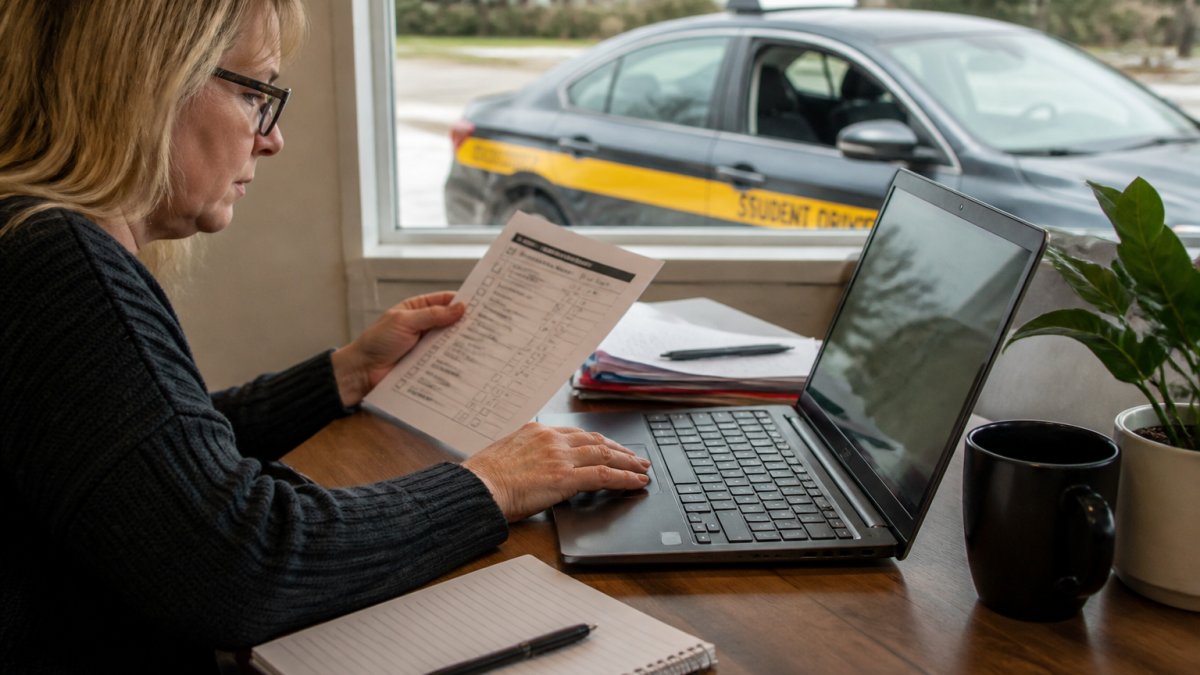
Use this checklist before you book:
- Confirm the instructor's state certification is current and look it up on the state agency site
- Verify the school holds a current driving school license
- Ask how many teen students the instructor taught in the past year
- Confirm the training vehicle has dual-control pedals and current inspection
- Ask how the school handles anxious or nervous students
- Request the written lesson plan and how progress is measured
- Read verified reviews that name the instructor, not just star ratings
- Confirm the school's service area covers your home
Measurable Safety Outcomes: What the Research Actually Shows
Honest answer: outcome data varies by program, and no single number proves one school is safer than another. What the research consistently supports is that supervised practice hours and structured instruction build skills faster than unsupervised driving alone. The CDC's teen driver safety guidance notes that teens are at higher crash risk in their first months of driving, which is exactly why structured training and parent-supervised practice matter.
Ask any school how it measures progress beyond hours completed. Programs that track skill mastery, not just seat time, give a clearer picture of whether your teen is actually ready. At Road Rules Driving School, we measure the quality of the driver, not just the license earned.
How Many Driving Lessons Do Teens Need?
The number of lessons a teen needs depends on prior experience and comfort level. Rather than chase a fixed number, aim for demonstrated competence: smooth lane changes, consistent speed control, and confident hazard response.
For state-specific licensing steps, follow the NJ Motor Vehicle Commission's graduated driver licensing guidance to confirm required supervised hours and permit stages. Lesson booking should follow your teen's progress, not a rigid calendar.
Parent-Teen Driving Practice Checklist
Parents can support practice at home. Rotate through these skills:
- Empty parking lot: starting, stopping, steering control
- Residential streets: speed management, scanning intersections
- Busy roads: lane changes, following distance
- Highway merging and exiting
- Night driving
- Rain or wet-road braking
- Parallel parking and three-point turns
- Hazard drills: sudden stops, pedestrian crossings
Building Safe Driving Habits for Teens That Last
If you want a course that builds these habits deliberately, explore the defensive driving course designed to reinforce them.
Transparent Total Cost Comparison
Sticker price is the least useful number in teen driver training. Two programs quoting the same tuition can differ by hundreds of dollars once you add the online course, road test fee, materials, and extra lessons. A transparent comparison breaks the total into line items so you can see where the money goes.
The line items that make up total cost
| Cost line item | What it covers | What to ask |
|---|---|---|
| Classroom or online driver education | State-required pre-licensing course | Is the course state-approved, and is the fee included or separate? |
| Behind-the-wheel lessons | In-car instruction hours | Is pricing per lesson, per package, or per hour? |
| Vehicle use and insurance | Dual-control car and coverage during lessons | Is insurance included, or does your family policy need to cover it? |
| Road test preparation | Practice for the state skills exam | Is test-day car use included, or charged separately? |
| State fees | Permit, license, and road test fees | Which fees does the school collect versus the state? |
| Materials | Workbook, online portal, certificate | Are materials bundled or add-on? |
| Extra lessons | Additional hours beyond the package | What is the per-lesson rate if your teen needs more? |
What the listed programs actually cost
For current pricing, request a quote from Road Rules Driving School.
The hidden costs most families miss
- Extra lessons beyond the package. A teen who needs four additional hours at a per-lesson rate can erase the savings of a cheaper base package.
- Road test car rental. Some schools charge a separate fee to use the training vehicle on test day.
- Online course fees. A "free" county program may still charge for the online component.
- Cancellation and rescheduling fees. Ask about the policy before you book.
- Insurance gaps. Confirm whether the school's commercial policy covers your teen during lessons or whether your family policy is primary.
How to compare on total cost, not sticker price
When you are ready to get current pricing, contact us to request pricing.
Frequently Asked Questions
What should parents look for in a teen driving school?
Ask about instructor credentials and curriculum structure. Look for a program that sequences skills progressively rather than just logging hours. Road Rules Driving School uses progressive skill development and clear educational objectives. Ask how the school measures readiness for the road test.
What qualifications should a teen driving instructor have?
Ask about an instructor's qualifications and teaching approach. For qualified driving instructors for teens, look for those who use a structured curriculum and can explain their teaching method. Road Rules Driving School emphasizes competency-based instruction.
How many driving lessons does a teenager need?
There is no single number. New Jersey's GDL program requires supervised driving hours, but the total varies by teen. Most students benefit from 10 to 20 behind-the-wheel lessons depending on prior practice and anxiety levels. Focus on mastery, not a fixed count: a teen is ready when they can handle complex traffic, hazard perception, and independent decision-making. Ask the school how they assess readiness rather than how many lessons they sell.
Are professional driving lessons worth it for teens?
Professional lessons can provide instruction. Road Rules Driving School's instructional framework includes progressive skill development, hazard perception, and decision-making.
How can parents help teens practice driving safely?
Use a parent-teen driving practice checklist that covers specific skills: parking, lane changes, highway merging, night driving, and hazard scanning. Practice in varied conditions and keep sessions focused. Ask the instructor what to work on between lessons and review the checklist together after each drive.
Comparing programs is the easy part. The harder question is whether your teen will actually be a safer driver when it is over. At Road Rules Driving School, we build instruction around competency-based progression, dual-control training vehicles, and programs like the Beginner Skills Lab™ that develop judgment, not just hours. Get started with Road Rules Driving School and give your teen the skills that last well beyond the road test.