 Comparison
Are Private Driving Lessons Worth It for Teens?
Last Updated: October 26, 2026
Quick Summary
Private driving lessons are one-on-one sessions with a licensed instructor, but alternatives include parent-taught instruction, online driver education, group lessons, and hybrid programs. Choose based on your state's licensing requirements, your teen's temperament, and your budget. A teen missing two or more core competencies needs targeted instruction.
- Parent-taught instruction costs the least but parents pass on their own habits, good and bad.
- Online driver education covers classroom theory only and includes no behind-the-wheel car time.
- Group lessons lower the per-hour cost but each teen spends most of the session watching.
- Most states require roughly 40 to 60 supervised practice hours, with some after dark.
- A teen who clears all five readiness competencies is likely ready with supervised practice alone.
Table of Contents
- Private Driving Lessons vs. the Alternatives: A Quick Comparison
- Parent Taught Driver's Education: What It Covers and Where It Falls Short
- Online Driver's Education for Teens: Convenient, but Not Behind-the-Wheel
- Group Driving Lessons for Teens: Lower Cost, Less Individual Attention
- Teen Driving Practice Hours: How Supervised Time Builds Real Skill
- State Rules for Supervised Practice and Approved Courses
- Total Cost of Each Pathway, Including Hidden Follow-Up Costs
- Assessing Your Teen's Progress and Deciding When Professional Lessons Are Still Needed
- Frequently Asked Questions
Private Driving Lessons vs. the Alternatives: A Quick Comparison
Private driving lessons are one-on-one behind-the-wheel sessions with a licensed instructor, and they are not the only route to a teen's license. Families now choose among parent-taught instruction, online driver education, group lessons, and hybrid programs.
The honest answer depends on three things: your state's licensing requirements, your teen's temperament, and your budget. Below, we compare every major pathway so you can match the format to your situation instead of defaulting to the most expensive option. The comparison covers instruction format, supervision needs, and what each route actually delivers.
| Pathway | Format | Instructor | Best For | Watch Out For |
|---|---|---|---|---|
| Private driving lessons | One-on-one, in car | Licensed instructor | Anxious teens, road test prep | Higher tuition per hour |
| Parent-taught instruction | Supervised family driving | Parent or guardian | Budget-conscious families | Skill gaps, bad habits |
| Online driver education | Self-paced or live virtual | None behind the wheel | Classroom credit, theory | No car time included |
| Group driving lessons | Small class, shared car | Licensed instructor | Cost per hour, basics | Less individual attention |
| Hybrid programs | Classroom plus private hours | Licensed instructor | Structured skill building | Scheduling complexity |
Parent Taught Driver's Education: What It Covers and Where It Falls Short
Parent-taught driver's education is a state-approved pathway in which a parent or guardian delivers the required classroom content and supervised practice hours. It costs the least of any option, and many states publish a formal parent-taught curriculum guide families must follow.
What it covers well: basic vehicle familiarization, parking lot drills, neighborhood driving, and the hours of supervised practice most states require before a road test. What it misses is harder to see. Parents teach their own habits, good and bad.
Watch out: some states restrict parent-taught instruction to a specific curriculum or require registration before practice begins. Check your state motor vehicle agency's rules before your teen logs a single hour.
Online Driver's Education for Teens: Convenient, but Not Behind-the-Wheel
Online driver's education for teens delivers the classroom portion, often self-paced, sometimes as a live instructor-led class. It satisfies theory requirements in many states and fits around school, sports, and work schedules.
Here is the limit most families discover late: an online course cannot teach car control. No self-paced module replicates the feel of braking on wet pavement or merging at highway speed.
If you are comparing course formats, check that the program is approved by your state's licensing agency before you enroll. state motor vehicle agency directory lists the agencies that publish approved provider lists.
Group Driving Lessons for Teens: Lower Cost, Less Individual Attention
Group driving lessons split a licensed instructor and a vehicle among several students, which lowers the per-hour cost. For a teen who has never sat in a driver's seat, a group session can be a low-pressure introduction to controls, mirrors, and basic positioning.
The trade-off is attention. In a car with three or four students, each teen spends most of the session watching rather than driving.
Group lessons suit teens who need exposure and confidence. They fit poorly for a teen preparing for a road test or working through a specific weakness.
Teen Driving Practice Hours: How Supervised Time Builds Real Skill
Teen driving practice hours are the supervised driving time a learner accumulates before the road test, and they are where skill actually forms.
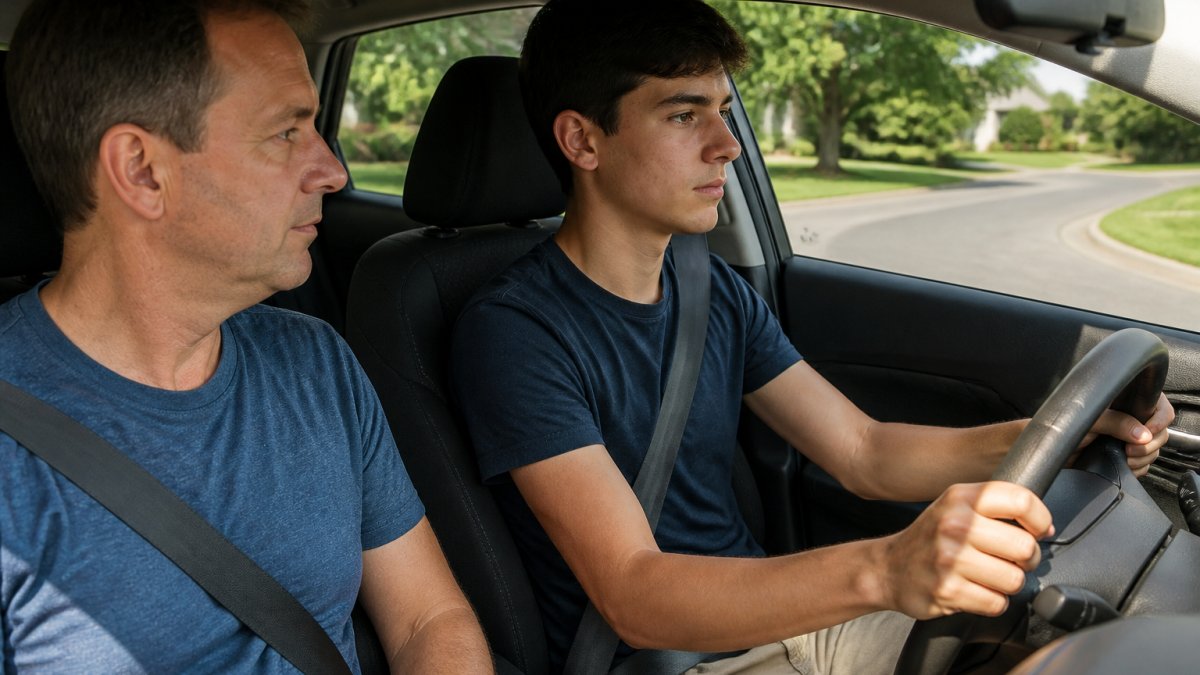
Why volume alone fails. A teen who drives the same easy route forty times is practicing confidence, not competence. The hours count on the log, but the skill does not compound.
A practice structure that turns hours into skill:
- Name one competency per drive. Pick a single target, mirror checks before lane changes, speed control on hills, following distance in rain, and make that the focus. One target per session beats five vague goals.
- Rotate environments. Alternate neighborhood streets, arterial roads, highway merges, parking lots, and night driving. Each environment stresses a different skill.
- Debrief in three sentences. What went well, what to fix next time, what to repeat. Keep it short so the teen stays engaged.
- Log as you go. Record date, duration, conditions, and focus area. A log that matches your state's format prevents rework at the road test.
- Escalate difficulty only after consistency. Move to harder conditions when the teen performs the current skill without reminders, not when the calendar says so.
How to tell whether logged hours reflect real skill. Use a simple readiness check before you decide professional lessons are unnecessary:
- Maintains lane position and speed without reminders
- Scans ahead and checks mirrors before every maneuver
- Handles intersections and right-of-way correctly under pressure
- Parks and reverses accurately in a tight space
- Stays calm and makes sound decisions in unfamiliar traffic
A teen who clears all five is likely ready for the road test with supervised practice alone.
This is where a structured program separates itself from informal practice. Road Rules Driving School sequences practice so each session adds a new competency rather than repeating the last one, which is how supervised hours can translate into judgment instead of mileage.
State Rules for Supervised Practice and Approved Courses
Licensing requirements for teen drivers are set at the state level, and the differences are not cosmetic. Before you choose any pathway, you need to know which of the following your state actually mandates, because each one changes what a parent-taught, online, group, or hybrid plan must include.
The variables that decide your pathway:
- Learner's permit holding period. Most states require a permit to be held for a minimum period, commonly six to twelve months, before a teen can take the road test. A shorter pathway does not shorten this clock.
- Supervised practice hours. States set a minimum number of behind-the-wheel hours with a licensed adult. Many require a portion of those hours after dark. The hours are logged, and the log is reviewed at the road test.
- Professional instruction requirement. Some states require a set number of hours with a licensed instructor or an approved driver education course; others make it optional but tie completion to insurance discounts or an earlier road-test eligibility.
- Approved-course rules. Where classroom or online education is required, the state publishes a list of approved providers. A course from an unapproved provider may not count, even if the content is identical.
- Parent-taught registration. Several states require a parent to register as the instructor, follow a state curriculum guide, or both before practice begins. Skipping registration can invalidate logged hours.
- Passenger and nighttime restrictions. Graduated driver licensing (GDL) phases limit who can ride with a teen and when they can drive. These restrictions apply regardless of how the teen learned to drive.
How to verify your state's rules in one sitting:
- Find your state motor vehicle agency through the [state motor vehicle agency directory | usa.gov].
- Locate the teen or graduated licensing page, not the general driver's license page.
- Download the parent-taught or approved-provider list if one exists.
- Confirm the practice-hour log format the agency accepts.
- Note whether a professional course is required, optional, or insurance-linked.
A parent-taught plan that satisfies one state's approved-course requirement may not satisfy another's, and a teen who moves mid-program can lose credit for hours that do not match the new state's log format. Verify before the first hour is logged, not after.
New Jersey families working through the graduated driver licensing program can review the teen driving program details to see how approved instruction fits the supervised-practice rules.
Total Cost of Each Pathway, Including Hidden Follow-Up Costs
Tuition is the visible cost. The hidden costs decide the real budget.
Parent-taught instruction looks cheapest until you count the hours a parent takes off work, the wear on a family vehicle, and the retest fees if the teen fails the first road test. Online driver education looks cheap until you add the private lessons most teens still need for car time.
Professional lessons carry the highest sticker price but often the lowest follow-up cost, because structured instruction targets the road test directly. For current rates and scheduling, the pricing and scheduling information answers the questions families ask before committing.
Assessing Your Teen's Progress and Deciding When Professional Lessons Are Still Needed
Use a simple assessment before you spend another dollar on any pathway. Score your teen honestly on these five competencies:
- Maintains lane position and speed without reminders
- Scans ahead and checks mirrors before every maneuver
- Handles intersections and right-of-way correctly under pressure
- Parks and reverses accurately in a tight space
- Stays calm and makes sound decisions in unfamiliar traffic
A teen who clears all five is likely ready for the road test with supervised practice alone. A teen missing two or more needs targeted instruction, and that is the point where professional lessons earn their cost.
If your teen is anxious behind the wheel, has already failed a road test, or has taken lessons elsewhere without progress, structured instruction is the better use of the budget. You can contact the school to ask questions or schedule lessons and talk through your teen's specific situation first.
Every family reaches this decision point: the practice hours are logged, the road test is booked, and the question is whether the teen is genuinely ready or merely eligible.
Frequently Asked Questions
Can parents teach their teens to drive instead of using a driving school?
Yes, parent taught driver's education is allowed in every state, though the required hours and permit rules vary. Parents can cover basic vehicle control and supervised practice hours, but they often lack structured hazard perception and defensive driving training. Many families combine parent practice with a professional program to meet state requirements and build test-ready skills. Check your state's licensing agency for the exact supervised hours and any approved course requirement before you start.
Is online driver's education enough for a teen to learn to drive?
Online driver's education for teens typically satisfies the classroom portion only. It cannot replace behind-the-wheel training, because driving skill develops through supervised practice in real traffic. A self-paced online course works well for the theory and permit test, but teens still need many hours of guided practice. Pair online coursework with parent-supervised drives or a professional instructor to cover the practical side.
How many practice hours does a teen need before the road test?
Most states require a set number of supervised driving hours, often 40 to 60, with some requiring a portion at night. Requirements differ by state, so confirm the exact figure with your licensing agency. Beyond the minimum, teens benefit from varied conditions: highways, rain, and heavy traffic. Track teen driving practice hours in a log, since many states require a signed record at the road test.
Are group driving lessons for teens a good alternative to private lessons?
Group driving lessons for teens cost less per session and can help with classroom learning and basic maneuvers. The trade-off is less individual attention and fewer repetitions behind the wheel. Group formats suit teens who already have solid parent-supervised practice and need affordable supplemental instruction. Teens who are anxious or struggling with specific skills usually progress faster with one-on-one time.
How do I know when my teen still needs professional lessons?
Watch for gaps in hazard perception, merging, lane changes, and parking, and note whether your teen stays calm under pressure. If they consistently miss hazards or freeze in traffic, professional instruction can help. A structured assessment lesson can identify weak areas and build a plan. Many families use a short block of lessons before the road test to refine skills rather than starting from scratch.